Marketing dashboard · for agencies
A dashboard the client actually reads. Not a report they file away.
A marketing dashboard fits on one screen and reads in ten seconds: the revenue generated, the channel that drove it, the link that converted. A client does not read a forty-page report — they’re looking for one number, and they give up if they can’t find it.
Three sentences. Always the same.
« “I spend two hours a month making a report nobody opens.” »
« “My client asks me in a meeting what was written on page 12.” »
« “They compare my numbers to their Analytics, and the two never agree.” »
« “When I ask for budget renewal, all I have to show is impressions.” »
The objection, in their words
My client doesn’t read my reports.
Because a report that starts with impressions requires effort before it delivers an answer.
This one starts with the month’s attributed revenue. Everything else is below, for anyone who wants to dig — and nobody needs to dig in order to decide.
The report sections
Four pieces, and the order matters as much as the content: the answer first, the proof second.
The month’s attributed revenue
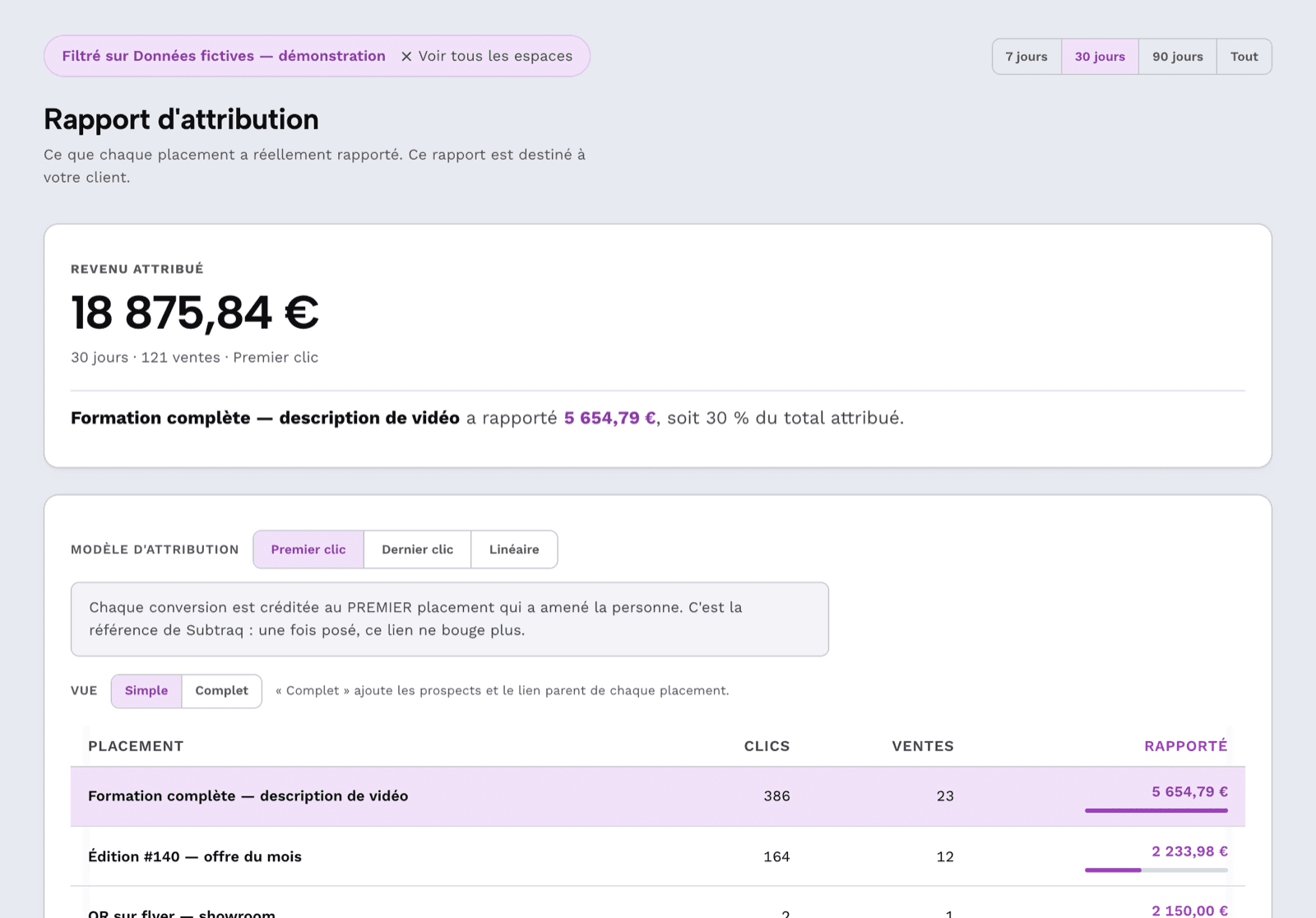
Up top, large, with the period. It’s the only line most clients will read, and it answers the question they’re asking.
What produced it, placement by placement
Each link distributed, its channel, what it brought in. An agency can then say “the story of the 12th brought in $2,100” instead of “stories are doing well.”
The period compared to the previous one
One number on its own says nothing. August versus July is a decision.
Your name, your logo, your domain
The document says nowhere that it comes from us. It’s your deliverable.
What it looks like
A report on a single screen
The report opens with a link. No twelve-megabyte attachment, no password to dig up, no account to create — three things that keep a report from ever being opened.
It reads on a phone, because that’s where an executive opens emails between meetings.
What this document is not
It’s a snapshot, not a window: a fixed month, sent at your initiative. The client doesn’t log in and sees nothing change. If they need to check anytime, without asking you, that’s a client workspace — and the two work very well together.
See client workspaces1
screen, and the number is on it
0
account to create to open it
∞
reports per client, no extra charge
« A client doesn’t want to know what you did. They want to know what it brought in. »
Send your first report this month
A demo workspace is already filled with sample data: you can see what the document looks like before connecting anything.
Open the demo