For affiliates and programs
Affiliation: the program says how much. Not where from.
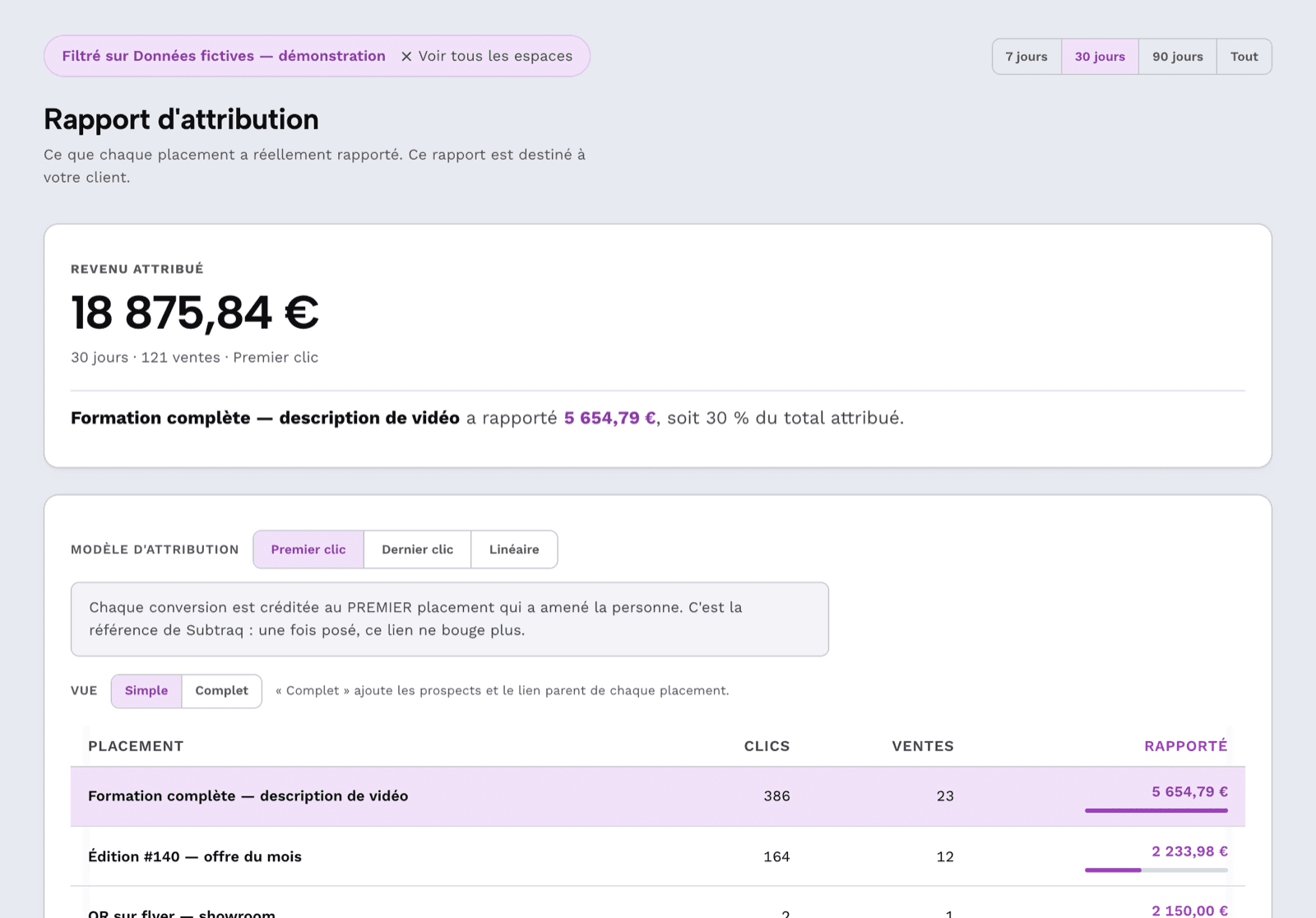
An affiliate link is an address you paste everywhere: a video description, a newsletter, a pin, an article. The program sees only one — yours. Subtraq puts one short link per placement, in front of the same destination, and counts what each one sent.
The blind spot
The same link, pasted in eight places
Your affiliate program counts correctly. It tells you how much you earned, and sometimes which product. It does not tell you which of your eight placements sent the buyers — and it cannot: it receives a single link, yours, with no idea where the visitor had just clicked it from.
Subtraq steps in one level upstream. You keep exactly the same affiliate link as the destination, and you build one short link per place you publish it. Eight short links, one destination, eight lines in the report.
Two dashboards, two questions
A total
The program adds up your commissions. It knows only one address: yours, pasted everywhere.
One line per placement
One short link in front of each publication. Each one counts for itself, and the report puts them side by side.
The program is right on the amount. It cannot be right on the origin: it never saw it.
Your affiliate link comes out intact
That is the only thing that truly matters here: an affiliate parameter lost along the way is a lost commission. Here is exactly what the redirect does.
Nothing is removed
The destination you paste is read as-is, with all its parameters. Subtraq only adds what is missing: your UTMs, and only if the key is not already written in your address. A value you set yourself is never overwritten, and no parameter is ever removed.
The referrer is preserved
The redirect response carries the header that passes the origin address through instead of erasing it. A program that looks at where the visitor came from therefore sees something, rather than a blank.
One extra parameter
Subtraq adds its click identifier to the final address. That is what allows a conversion to be linked to a specific click. If your program prohibits additional parameters, check its terms before starting — we cannot know that for you.
Two situations, two answers
You distribute, or you collect
You are an affiliate — you distribute someone else’s link. Subtraq counts clicks by placement, channel, and period, and that is already the answer to “which one should I redo.” The revenue, on the other hand, stays with the program: no affiliate platform calls our API to report it. It only comes in if you send it yourself.
You run a program — other people distribute your links. There, the chain is complete: payment goes through your account, the sale comes back signed, and affiliation becomes a channel compared to the others in revenue, not in clicks.
Organizing a hundred links without getting lost
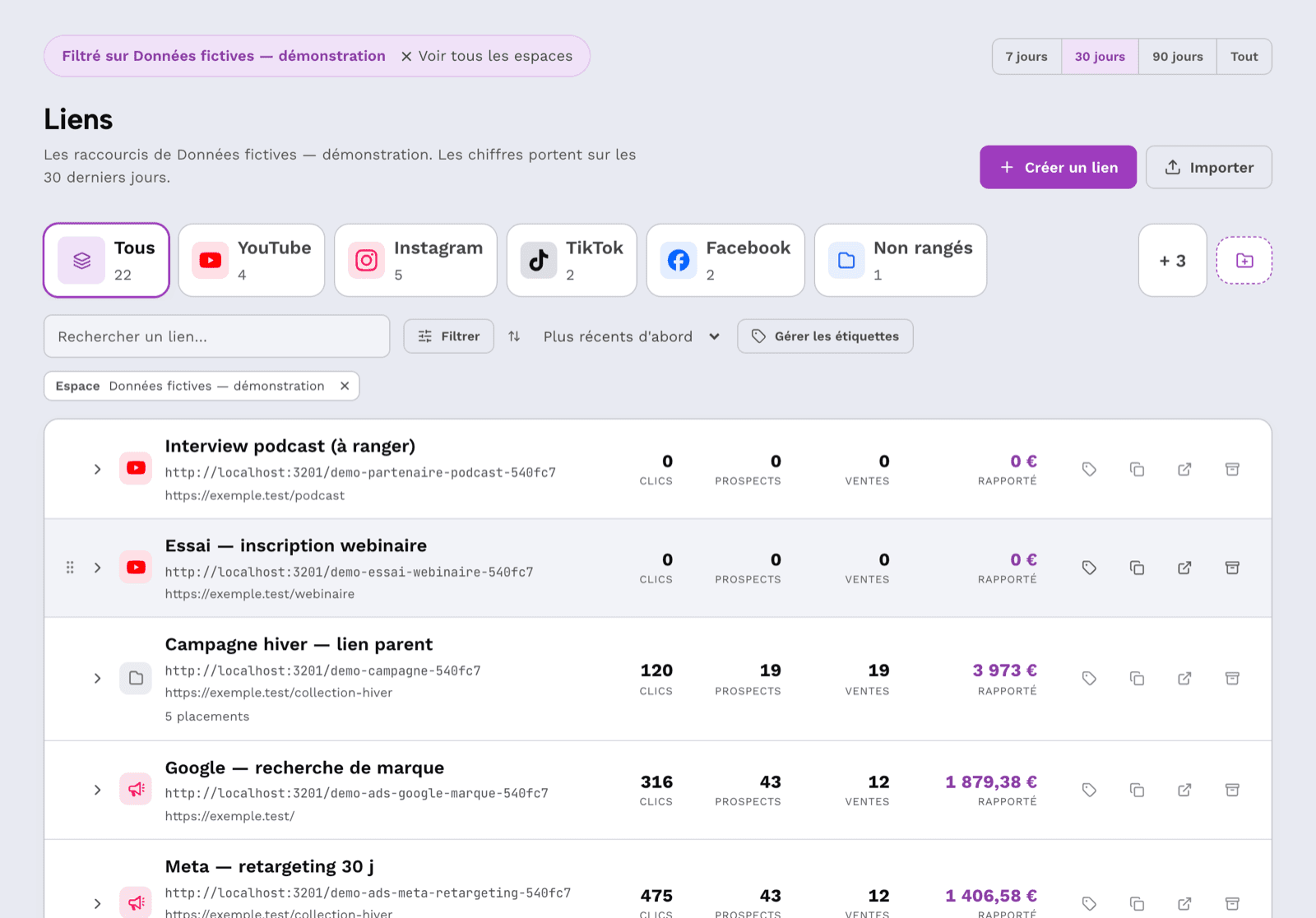
An affiliate does not have three links — they have a hundred. Organization is not a comfort: it is what makes the report readable after six months.
Folders
A folder carries one channel — the video, the newsletter, the pin. Organizing by destination would create a 'my product page' folder where everything ends up. Organizing by channel creates 'what the newsletter sent,' which is the question. Folders count toward no plan: organizing costs nothing.
Tags
One color per program, brand, or season, applied to as many links as you like. One link can carry several — that is what lets you cross 'the newsletter' and 'that program' without building a hierarchy.
Bulk import
If your links already exist elsewhere, they come in through a file rather than one by one, with their destination and channel. Your plan's link limit still applies: that is the entry counter for the free tier.
The places you distribute
The channel is where the link was published — never where it sends. All your affiliate links point to the same place: that is precisely why the channel is the only thing that distinguishes them.
30
day attribution window, by default
10
links per month on the free plan — then /pricing
0
parameter removed from your destination
An affiliate's objections
Five questions, including one where the honest answer is 'not on its own.'
"Will my commissions show up in revenue?"
"Will the program parameter survive?"
"Does it hide my affiliate link?"
"What if I exceed the click quota?"
"I publish in several languages, across several countries."
What changes on a Monday morning
You'll know where to start again.
In a month, an affiliate publishes one video, two newsletters, four pins, and one article. At month's end, the program shows a total. The breakdown exists nowhere.
Without anything upstream, the decision is made by feel: you redo the pins because you like making them, you drop the newsletter because it takes time. You are wrong every other time, and you never learn it.
With one link per placement, it is made on a single line: the video sent this much, the newsletter this much, the pin this much. You know where to start again, and you know it on Monday.
Which of your placements sent the buyers?
Know with the next clickFrequently asked questions
Can I track an Amazon affiliate link?
Technically, yes: your affiliate address becomes the destination of a short link, and its parameter is not modified. An honest caveat, however: affiliate programs each have their own rules on redirects and added parameters, and Amazon's is no exception. Read yours before generalizing — it is the kind of rule you cannot guess.
Do I need a different short link per publication?
Yes, and that is the whole point. A single short link everywhere would give you exactly what the program already gives you: a total. One link per placement means one line per placement.
How does a conversion find its link?
By the first click. Once the first touch is placed on a person, nothing moves it, and that click must fall within the workspace's attribution window — thirty days by default. A bot click never credits anything.
What if no one clicked one of my links before buying?
The conversion is recorded as unattributed, and it shows as such. A report that invents a plausible origin is worse than an incomplete one.
I run my own affiliate program. Is this the same page?
It is the same tool, with more possible. Since payment goes through your account, the amounts come back signed and affiliation becomes a channel compared to the others in revenue. One workspace per partner gives them their own report, openable by a link, no account needed.
Can I compare several programs in one place?
Yes, on clicks: one tag per program, and the report puts them side by side. On revenue, only for programs you send the amounts up for — otherwise the column would stay empty, and an empty column is better than an invented one.
Do my links stay valid if I stop paying?
Redirection is the product's most important promise, and the free plan has no end date. What changes between plans is the number of workspaces, links per month, counted clicks, and domains — details are on the pricing page.
You collect payments yourself?
Stripe, Systeme.io, Tally, Typeform, Brevo, WordPress with Elementor, Zapier, and Make each have their own guide, sourced from their official documentation and dated.
See all connected toolsShort links, free →
One destination, one link per placement, and the counter behind it.
Tag a campaign →
UTM parameters built cleanly, without getting the keys wrong.
QR for print →
A redirectable code after printing, counted at every scan.
One link per placement, starting today
Create the account, paste your affiliate link as the destination, build one per publication. The first report arrives with the first click — and the free plan has no end date.
Create a free account