Marketing attribution
Marketing attribution: which link sold
Someone sees your LinkedIn post, signs up to your newsletter twelve days later, then buys after a story. Which one sold? Depending on the model you choose, the answer differs — and it is on that answer that you decide where to put your budget next month.
One sale. Three ways to share it.
One hundred and twenty euros banked, three touchpoints before. Here is what each model does with it.
Inside the product
Three models. The same figures.
You switch from one model to another without recalculating anything: the attributed revenue redistributes before your eyes, down to the cent.
And no currency is ever converted. Revenue in euros divided by spend in dollars gives a number that looks like a result and is not one. When the two do not match, the figure stays empty — a gap is visible, a wrong number is not.
Every placement weighed. In revenue.
That is the sentence an agency cannot say without attribution — and the one that decides where next month's budget goes.
30 %
of attributed revenue comes from “video description”
18 875,84 €
of revenue tied to a precise placement, over thirty days.
Demo workspace · 121 sales · first-touch model. Without attribution, that amount exists too — but nobody knows where it came from.
From the click to the revenue. Three links.
Three links in the chain. Break one, and the chain says nothing.
1 · The click
One short link per placement — not one per campaign. The story's link is not the bio's: without that distinction, you will never know which one paid.
2 · The touchpoint
The click drops a token. When the person leaves their email, the token travels with it. That is where most chains break, because the form does not carry it — and that is what sales tracking fixes.
3 · The sale
The payment comes back through a signed webhook. At that moment, and not before, you can say what the placement brought in.
« It is true, it is verifiable, and it does not answer the question. »
What a volume report says: views, clicks, one global revenue figure.
Choosing your attribution model
Each answers a different question, and gets the others wrong.
| Model | It answers | It gets it wrong when | On our €120 |
|---|---|---|---|
| First touch | What makes people discover me? | The cycle is long and the first touch is an unremarkable article | 120 / 0 / 0 |
| Last touch | What triggers the purchase? | The last click is retargeting — it harvests what others sowed | 0 / 0 / 120 |
| Linear | Which channels take part? | One touchpoint is decisive and gets drowned out | 40 / 40 / 40 |
Inside the product
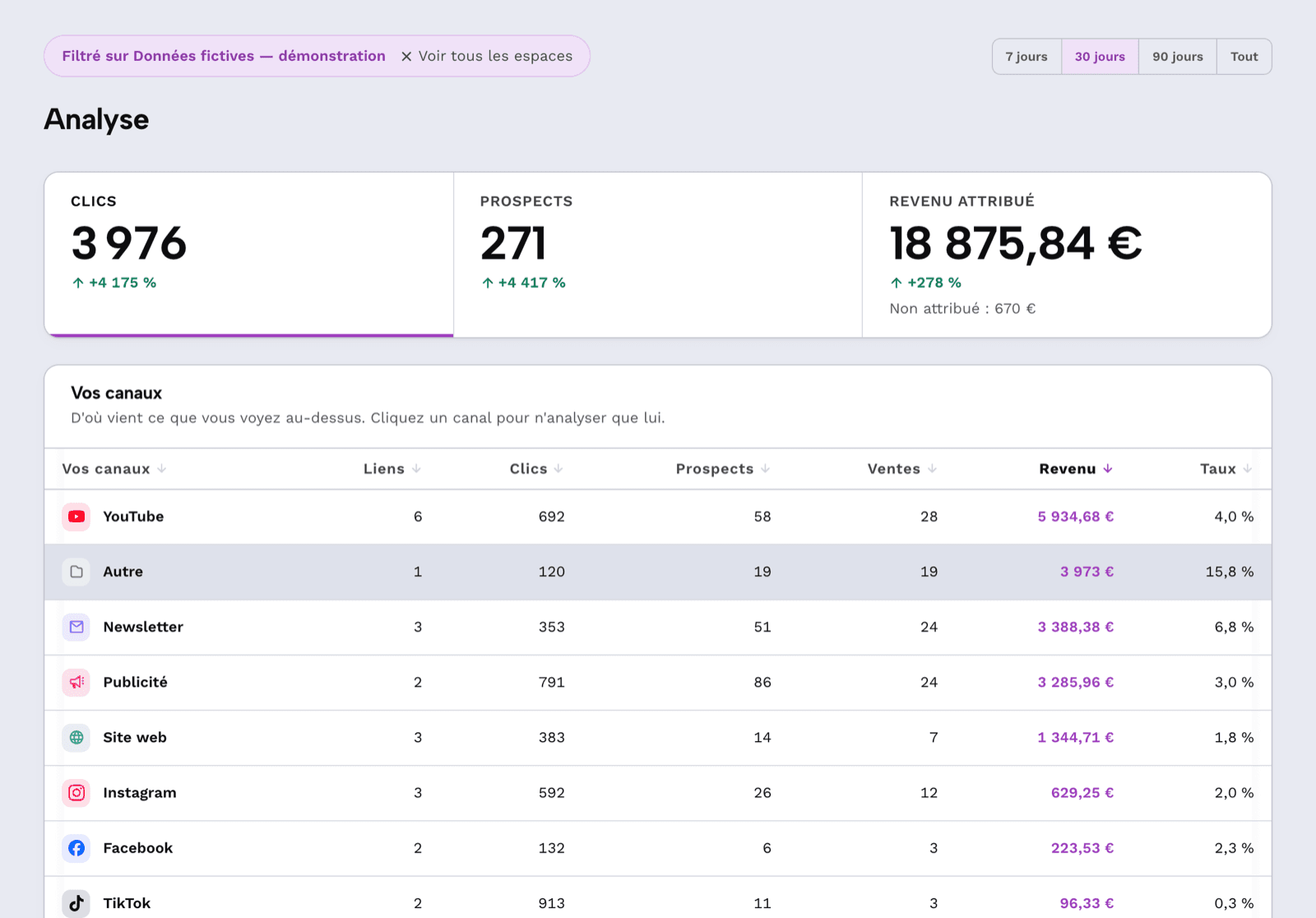
The same calculation, by channel
The table above is drawn — it will not age with the interface. This one is a screenshot of the product as it runs, so you see what it actually looks like.
The Spend and ROAS columns only appear when there is spend: a half-empty table says nothing.
Three channels have their own page: YouTube, LinkedIn and Instagram.
3
models, calculated at the same time
22
publishing channels recognized
0
currency conversions, ever
For developers
Split, never counted twice.
Amounts are in cents, never in floats: a float on money always ends up lying by a cent, and one cent per sale over a year shows up in a client report.
The remainder of the division goes to the first touch, so that the parts add up to exactly the amount banked.
GET /api/v1/analytics?model=linear

{
  "currency": "EUR",
  "rows": [
    { "linkId": "…", "revenue": 4000 },
    { "linkId": "…", "revenue": 4000 },
    { "linkId": "…", "revenue": 4000 }
  ],
  "total": 12000
}
Six terms worth knowing
Attribution
The operation that ties a conversion to one or several earlier touchpoints. The whole disagreement sits in “or several”.
Touchpoint
A traceable interaction before the conversion: a click, an open, a scan. What is not traceable does not enter the calculation — that is the honest limit of the exercise.
Multi-touch
Any model that spreads credit across several touchpoints instead of naming one. Linear is its simplest form.
UTM
Parameters added to an address to say where the click came from. They work — until someone shares the link without them.
Attribution window
How long a touchpoint can still claim a sale. Too short and you lose long cycles; too long and you credit a January post for a June purchase.
ROAS
Revenue divided by ad spend. It requires knowing the cost — the half of the calculation almost nobody automates.
The common objections
Google Analytics already does it, and it is free
We add UTMs and track it in a spreadsheet
Without third-party cookies, attribution is dead
My sales cycle takes six months
Does your form carry the token?
It is the link that breaks most often, and always silently: the form goes out without the token, the sale arrives with no origin, and the report says “direct”.
See how to connect itThe same sale, three truths
First
All of it to the post that made the brand known.
Last
All of it to the link that triggered the purchase.
Linear
Forty euros each. Nobody did all of it.
Frequently asked questions
What is the difference between attribution and tracking?
Tracking records what happened: a click, a visit, a purchase. Attribution decides who gets the credit. You can track everything and attribute nothing — which is the situation of most agencies, with figures everywhere and no answer.
Which attribution model should you choose when starting out?
Last touch, because it is the easiest to explain to a client, then linear as soon as you have enough volume to see multi-step journeys. What matters is not changing model mid-month: the figures would no longer be comparable.
Do you need a developer to set up attribution?
Not for the common cases. One short link per placement takes seconds to create, and the most widespread tools — Tally, Calendly, Systeme.io, Stripe — connect through their own interface, with no code. A developer becomes useful for a bespoke site or an app.
Is marketing attribution compatible with GDPR?
It can be, and it is here: the data stays that of your own domain, no third-party cookie is dropped, and nothing is resold. What troubles GDPR is cross-site advertising tracking, not knowing which of your own links led to a sale.
How long before the data is usable?
The length of one full sales cycle, and no less. On a product bought within days, two to three weeks is enough to see trends; on a six-month cycle, the first complete figures arrive at six months. Any faster promise is talking about sessions, not sales.
Your figures. Our calculation. Free.
A real attribution report, with its three models side by side on the same data. No account to create, no sales call.
Open the demo