ROAS formula
Calculating your ROAS takes one division. Knowing if it is good takes two.
ROAS = revenue ÷ ad spend. $1,890 in revenue for $450 spent gives 4.20×. The calculator adds break-even ROAS and cost per acquisition. No account or sign-up needed.
It sets the point where your ROAS starts making money. Move it around: the marker moves with it.
Your ROAS
4.20×
Every dollar spent brings back 4.20 — above your break-even. The campaign is making money.
Profit after ad spend
$684.00
Nothing leaves your browser: the maths happens here, and none of these values are sent anywhere.
The formula, and the trap it hides
ROAS takes one division. What is hard to calculate is the threshold at which it becomes good.
ROAS = revenue ÷ ad spend
$1,890 in revenue for $450 spent gives 4.20×. Every dollar spent returned $4.20 — in revenue, not in profit.
Break-even ROAS = 1 ÷ margin
This is where most people go wrong. At 60% gross margin, you need a ROAS of 1.67× to break even: one dollar spent requires $1.67 in revenue to be covered. At 25% margin, the threshold rises to 4× — and a 3.5× ROAS you thought was excellent becomes a loss.
Cost per acquisition = spend ÷ sales
The number you compare to average order value. If CPA exceeds the margin on one sale, every additional sale deepens the hole faster.
« A ROAS is only good or bad relative to your margin. »
That is why this calculator asks for your margin, not just the two amounts.
Four terms to know
ROAS
Return On Ad Spend. Revenue generated divided by ad spend. Read as a multiple: 4× means four dollars returned for every one spent.
Break-even ROAS
The minimum ROAS to avoid losing money once margin is applied. It depends on your margin, not the industry.
CPA
Cost per acquisition: what one sale costs in advertising. Useful for comparing two campaigns that have different average order values.
ROI
Often confused with ROAS. ROI counts PROFIT, subtracting all costs; ROAS only looks at revenue and ad spend. A strong ROAS can hide a negative ROI.
The real problem is not the division
It is knowing which revenue to put in the numerator.
This calculator assumes you know the attributed revenue for your campaigns. Most people don't: they take total monthly revenue and divide by ad spend. The result goes by the name ROAS, and it means nothing — it credits advertising for sales driven by word of mouth, newsletters, and customers who were coming back anyway.
Mapping each sale to the placement that drove it is the other half of the work. That is what attribution does, and what automatic spend import completes — so ROAS calculates itself, from numbers that come from the ad network, not a spreadsheet filled in by hand.
Without the calculator
ROAS calculated automatically
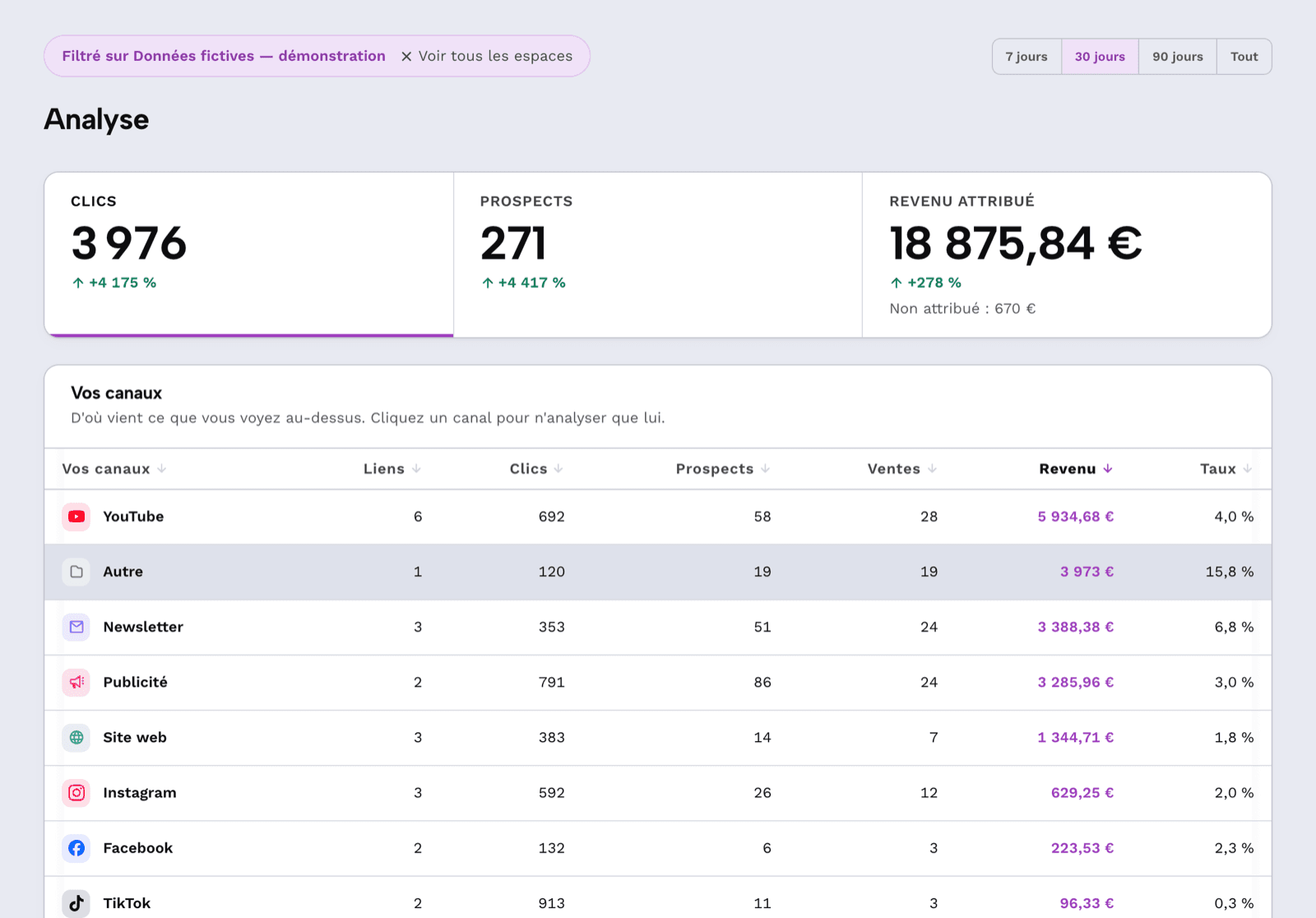
Here, revenue comes from attribution and spend comes from Meta — there is nothing to enter, and nothing to copy.
That is the difference between calculating a ROAS once by hand, and watching it update every day by placement.
Do you know your attributed revenue?
Most people take their total monthly revenue and divide by ad spend. The result goes by the name ROAS, and it means nothing — it credits advertising for sales driven by word of mouth.
See how to get itFrequently asked questions
How do you calculate ROAS?
You divide revenue generated by a campaign by what it cost in advertising. $1,890 in revenue for $450 spent gives a ROAS of 4.20×. The result reads as a multiple: every dollar spent returned $4.20 in revenue.
What is a good ROAS?
There is no universally good ROAS. It is good once it exceeds your break-even threshold, which is 1 divided by your gross margin. At 60% margin, the threshold is 1.67×; at 25% margin, it is 4×. The same ROAS of 3× is excellent in the first case and unprofitable in the second.
What is the difference between ROAS and ROI?
ROAS only compares revenue to ad spend. ROI compares profit to total costs — production, salaries, tools, ad spend included. A 4× ROAS can correspond to a negative ROI if margin is thin or fixed costs are high.
Does this calculator save my figures?
No. All calculation happens in your browser, in JavaScript, and no value is sent to a server. You can close the tab; nothing has been transmitted or stored.
The only number that settles it
< 1
Below 1
Every dollar spent returns less than one. The campaign is burning money.
= 1
At 1
The threshold. You are breaking even, and nothing more.
> 1
Above
Advertising stops being a cost. It becomes an investment.
Automate your attributed revenue
The calculator asks for attributed revenue. Subtraq calculates it: each sale traces back to the placement that drove it, and Meta spend imports automatically alongside it.
See how