For agencies
“So, what did it actually do?”
Next month they will ask again. You will answer in one sentence, with a number — because every dollar earned will be linked to the placement that drove it, in a report your client opens without an account, under your name.
Three sentences. Always the same.
« We know the campaign worked, but we can’t back it up with a number. »
« The monthly report takes me half a day, and I’m not sure anyone reads it. »
« The client compares what we cost them to what they think we bring in. They think wrong. »
The move
We no longer start from the click. We start from the sale.
An agency’s question is not “how many views.” It’s which of my nine placements drove that particular sale.
That is the exact opposite of what a classic dashboard knows how to do — and it is the only direction that answers the question you are asked.
2
client workspaces in the free plan
15
on the paid tier, at $39 per month
21
recognized distribution channels
What the client receives
Your logo. Our numbers. Their trust.
It opens through a link, no account needed. On the paid tier, the Subtraq name disappears: it is your document, not ours.
And it goes out on its own on the first of the month, if you want. A late report gets noticed; a missing one does not.
« It’s accurate, it’s verifiable, and it doesn’t answer the question. »
What a volume report says.
All their channels. One table.
The channel is where the link was distributed — not where it points. That distinction is what makes the phrase “what YouTube brings in” meaningful.
One month, two tools. Only one answers.
Drag the handle. On the left, what you do today.
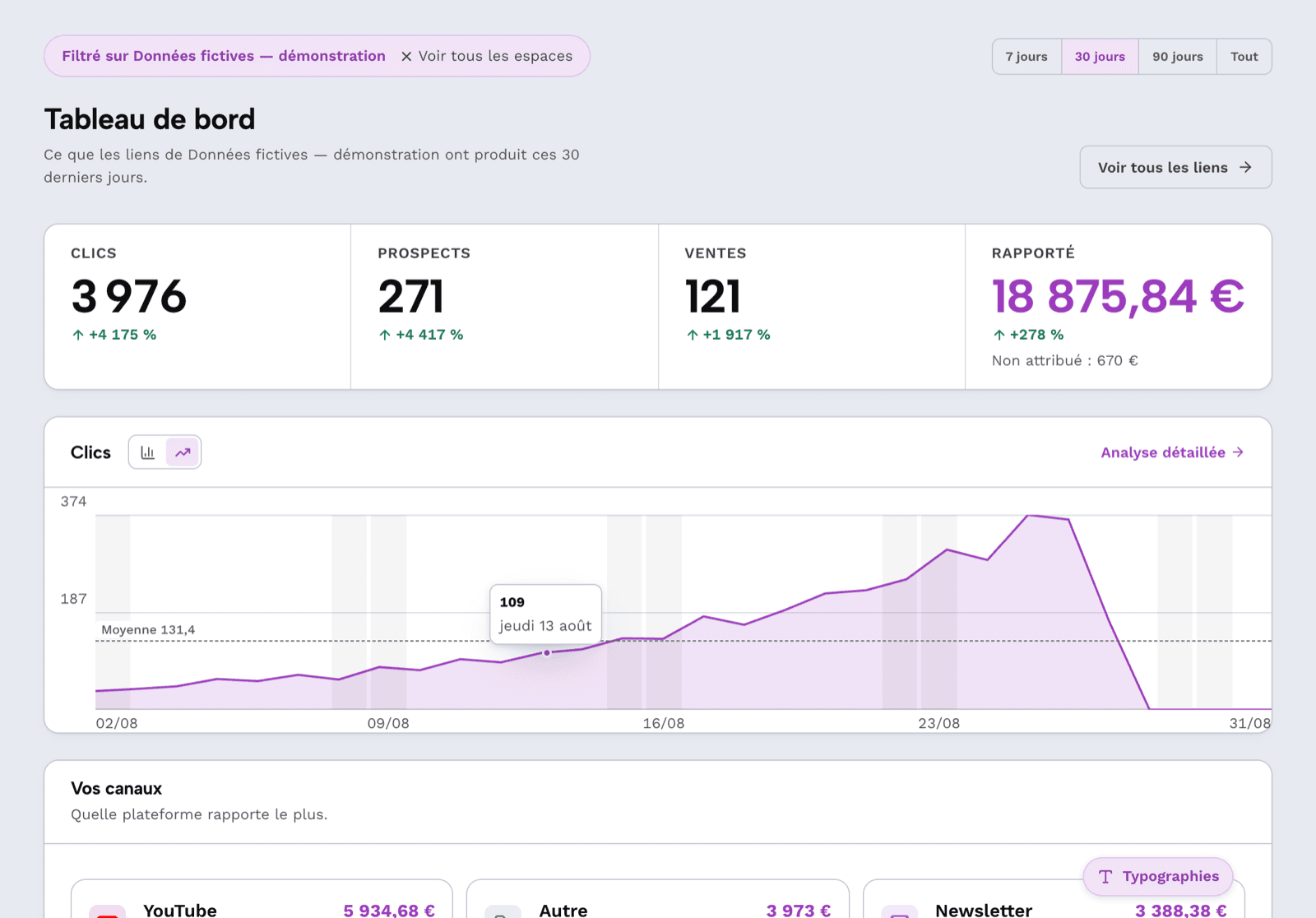
Exact volumes, with no way to know which one drove the $18,875.
Which of your placements paid last month?
Find out in ten minutesWhat changes every Monday
An agency runs nine placements for a client: three LinkedIn posts, a newsletter, two stories, a bio link, an ad, and a QR code on a flyer. At the end of the month, the client asks where the budget went.
Without attribution, the answer is all volume: views, clicks, and a total revenue figure with no way to tell where any of it came from.
With it, it fits on one line: the newsletter drove 4 leads and 1 sale at $120, the ad drove 3 for $47 in spend. You know what to cut and what to double — and your client can see it for themselves.
What the client is really buying
You no longer sell visibility. You sell revenue.
A walled-off workspace per client, a report under your name they open without an account, and the month’s revenue placement by placement. That is what gets a budget renewed.
Written by an agency, on its own clients.
How it works →
Attribution, three models, and why the choice changes the answer.
ROAS calculation →
Revenue, spend, break-even — without exporting three spreadsheets.
Pricing →
Two free client workspaces, no expiry, no credit card.
Start with one client. It’s free.
One workspace, a few links on the month’s placements, and the first report fills itself. The free plan covers two — enough to judge without committing to anything.
Create my first workspace